MARINE ECOLOGY
  • Home
  • Blog
  • Research
    • Microplastics
    • Oyster Mortality
    • Tipping Points
  • CV and Publications
  • Contact Me

BLOG

New posts weekly!

Our Students Do Arts and Crafts: Part 3

4/4/2024

0 Comments

 
Picture
This week, the students spent another week collecting data at the marine lab and began finalizing their final paper drafts. The drafts are due next week, so this week was a major push to collect as many data points as possible to maximize the strength of their statistics and interpretation. Unlike some draft papers, the final paper drafts must be completed  and ready for submission, as if they couldn't edit the paper after turning it in. We will provide feedback and they will incorporate this feedback plus additional data over the next few weeks to present their finalized version of this assignment. One of the many things I love about supporting this class is that students have so much flexibility once we are at the lab and can use their time as they see appropriate. They may ask one of the TAs or faculty for writing support or questions on statistics, they might set up another run of their experiment, or they might come to the lab with the class to work on their writing out in the sunshine by the ocean. Today was a great day for writing by the ocean, as there were dolphins feeding really close to shore that were a sight to see.

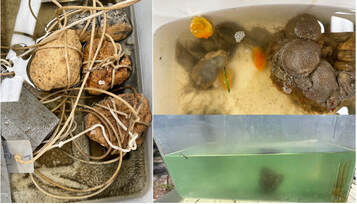
The three projects here represent some of the most common and the most uncommon type of project our students designed. Many students developed projects to evaluate some aspect of larval settlement, which is pictured on the left. By modifying some feature of the settlement surface (the type of material, texture, color) or the location or orientation of the settlement plates, the students are counting the number of settlers or the number of types of organisms that settle on the plates. While settlement projects are straightforward at the start and during the set up phase, they get more difficult when the students collect the data, because they are looking under the microscope for tiny larvae and moving around the entire settlement tile to find these organisms.

The bottom right project is using ascidians (sea squirts) as water filters and modifying some aspect of their environment or biology to see how their filtration capacity changes. Many of the students doing this filtration-style project added phytoplankton to the water and are taking pictures of the tanks to evaluate how the shade of the green color changes over time, as a proxy for filtration capacity. Additionally, since many of the students are interested in how salinity affects filtration capacity, they are getting experience using salinity meters and fake ocean salt to create environments that are as saline as they'd like. Some have decided that perhaps their maximum salinity should be the level already at the lab and are diluting the coastal seawater to make less saline treatments.

Finally, the most surprising and unique project is pictured in the top right. Two students were interested in understanding aspects of settlement and development in a manipulated setting, so they dissected the gonads from ascidians, induced spawning, fertilized the eggs, and then transplanted them to different conditions to see how development and settlement changes across a few conditions.Thank goodness the other TA studied ascidians for part of his dissertation and could help with the logistics of the project because I would not have known where to start with the students' ideas.

All in all, a really productive week for the students. As for me, I've been working on editing a manuscript that I'm getting ready to submit to a journal, talking to multiple interested agencies about job prospects, and starting to prepare materials for our FSUCML Open House. Stay tuned for more updates next week.

0 Comments


Leave a Reply.

    Categories

    All

    RSS Feed

Powered by Create your own unique website with customizable templates.
Photos from unukorno, Grace Courbis
  • Home
  • Blog
  • Research
    • Microplastics
    • Oyster Mortality
    • Tipping Points
  • CV and Publications
  • Contact Me