MARINE ECOLOGY
  • Home
  • Blog
  • Research
    • Microplastics
    • Oyster Mortality
    • Tipping Points
  • CV and Publications
  • Contact Me

BLOG

New posts weekly!

Our Students Do Arts and Crafts: Part 2

3/28/2024

0 Comments

 
Picture
And this time I have photos of the arts and crafts. This week was such a fun week at the lab with the students, as they continued working on their independent projects. In a few weeks, the students will present their rough drafts and then spend two weeks finishing their projects before they present their work to the class. While some of the students realized that their initial ideas were too ambitious, either because of the size of their experimental replicate or the number of samples they wanted to collect, many of the students made good progress collecting more data and some even started analyzing and visualizing their initial results.

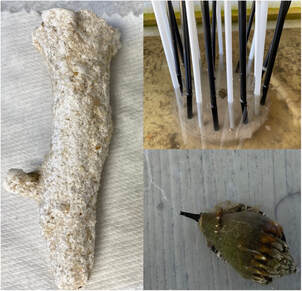
Here I'm highlighting three cool projects, and I will highlight a few more next week. On the left is a plaster cast that one student made for their project on fiddler crab burrowing. The student found a study that used plaster to measure crab burrowing activity, and they have had really great success using this method to evaluate how crab activity may changed based on the presence of visual cues. I'm highlighting this experiment because I didn't have high hopes for the plaster casting, since sediments are quite porous. I was worried that the cast wouldn't be a solid structure, but these artifacts have turned out great.

In the top right is an experiment where a student is replicating features from a 1970s study on snail behaviors. These snails climb up salt marsh grasses to avoid predatory crabs, and they also climb on the grasses to feed. However, salt marsh grasses are really important to ecosystems and provide structural stability to sediments, so the degradation of the grasses can alter the landscape of the ecosystem. The student created blocks with different colored straws to evaluate if the snails are using color or shade cues to determine where to climb. I snapped this photo at the start of a trial, and the snail is currently in the center of all the straws.

Finally, in the bottom right is a photograph from the early stages of a student's experiment, where the student is evaluating how salinity affects crown conch feeding activity. As global climate change affects ocean salinity, organisms may struggle to tolerate new conditions, or may experience stress. Perhaps organisms may need more energy to accommodate their stress responses. Here the student is evaluating the feeding activities of these gastropods by presenting them with shrimp (store bought, not fresh) and maintaining the conchs in different salinity environments.

A reminder that if you are in the Florida big bend area, the FSU Coastal and Marine Laboratory is hosting its Open House on Saturday, April 20 from 10 am - 3 pm. All of our labs will be showcasing our research, including live animals, poster presentations, activities for kids and adults, and so much more. Come down to the lab, we'd love to see you.

Tune in next week for more arts and crafts and animals updates from the students' projects.

0 Comments


Leave a Reply.

    Categories

    All

    RSS Feed

Powered by Create your own unique website with customizable templates.
Photos from unukorno, Grace Courbis
  • Home
  • Blog
  • Research
    • Microplastics
    • Oyster Mortality
    • Tipping Points
  • CV and Publications
  • Contact Me