MARINE ECOLOGY
  • Home
  • Blog
  • Research
    • Microplastics
    • Oyster Mortality
    • Tipping Points
  • CV and Publications
  • Contact Me

BLOG

New posts weekly!

Into the Unknown

10/26/2023

0 Comments

 
Picture
This week featured me wrapping up all of the known aspects of this final chapter of my dissertation. What I mean is that I finished counting all the meiofauna and I will finish their biomasses this weekend. After nearly 4000 individual animals, the meiofauna or known part is done. The next step is the unknown--the macrofauna. Macrofauna are the organisms that exist one size class above meiofauna. Where meiofauna are commonly defined as organisms with body sizes 32-500 micrometers, macrofauna often exist between 500 micrometers and 5 cm. While these size ranges shift depending on the environment (deep sea shifts toward smaller organisms), the rough size classification system is based on sieve mesh sizes, which is why the larger mesh size that I use in my research is 500 micrometers. This larger size retains all organisms at 500 micrometers and larger, while the meiofauna pass through the mesh and into the smaller sieve below. 

Once we separate the macrofauna and meiofauna by sieve size, we transfer the macrofauna to sampling jars, add a fixative, usually formaldehyde (formalin), and then store the samples away, often to never see the light of day again unless a researcher is interested in those organisms. Therefore, we do not have macrofauna expertise nor guidebooks in our lab for identifying these animals. While we can likely identify the animals to very broad taxonomic classifications (think identifying a monarch butterfly as an insect and no further), the data I need for my experimental analysis has to be more rigorous (think identifying a monarch butterfly as Genus: Danaus or as Danaus plexippus). The specificity in this chapter of my dissertation is important, as I will assign each animal a mobility and a sediment reworking score based on its life history traits. These scores have been defined by other scientists so the closer I can get to their level of specificity, the better the accuracy of my classifications.

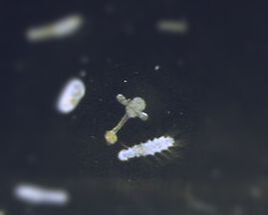
Next week I will be taking a week off from the blog as I use next week to take a short mental health break. This work has been quite tiring and I want to ensure that my work is reflective of the scientist I am, rather than reflective of my level of focus. I will spend some time identifying some of the remaining unknown meiofauna from the remaining organisms, including this little critter that looks like a fun microscopic fire hydrant. See you in two weeks.

0 Comments


Leave a Reply.

    Categories

    All

    RSS Feed

Powered by Create your own unique website with customizable templates.
Photos from unukorno, Grace Courbis
  • Home
  • Blog
  • Research
    • Microplastics
    • Oyster Mortality
    • Tipping Points
  • CV and Publications
  • Contact Me